A Terrible Beauty.

My back was to the Yeats Society Building when I heard the chanting from O’Connell Street in Sligo. I saw a festive set of tricolors being held aloft, and I pulled my phone to take a photo of what I first thought was a parade celebrating Irish heritage.
“Whose country?” a man with a toy megaphone shouted at the head of the assembled marchers. “Our country,” the marchers replied.
I put my phone back in my pocket when I realized the parade consisted of a few dozen racists marching to declare their alleged superiority. One of the marchers, strode and smiled and held her sign upside down.
On the other side of the Hyde Bridge a young woman with brown skin stood huddled in an alcove, with a look of deep concern on her face as the xenophobes continued their singular chant.
As if God was watching, the skies opened, as they do often in Sligo, and the marchers were drenched in what felt like a targeted downpour.
As I write this, a left-leaning, self-proclaimed unifier, Catherine Connolly, has been declared the new president of Ireland, in a landslide. Ireland’s president is largely ceremonial, and Connelly must deal with a parliamentary government led by a central right leader.
In her acceptance speech she articulated her vision for her country, "I will be a voice for peace, a voice that builds on our policy of neutrality, a voice that articulates the existential threat posed by climate change…but my message is, use your voice in every way you can, because our public and democracy needs constructive questioning and, together, we can shape a new republic that values everybody, that values and champions diversity and that takes confidence in our own identity.”
Back in Dublin, a series of right-wing riots continues after an immigrant suspect was accused of sexually assaulting a ten-year old Irish girl. The world is small, and ugly.
My trip to Ireland was not meant to escape the divisive horrors of the Trump administration It wasn’t meant to wash the images of masked abductors from my mind, or to seek escape from the daily outrages as a set of fascists strives to tear the US down for the benefit of a small group of oligarchs.
But the trip has had some of that effect, as trips often do. They provide a perspective not available in the day to day.
Yesterday at a bookstore (this modest-sized town has three), a Sligo native regaled the clerk with the story of recently meeting a Texan.
The Texan had just stepped into a pub after a drenching rain. “Y’all from around these parts,” the Texan asked the Irishman. The Irishman said he was. “Is it always like this?” the Texan asked. “No, it’s different in the summer,” the Irishman said. “Really? How so?” the Texan wondered. “The rain is warmer,” the Irishman laughed as he touched the bookstore clerk’s hand.
Last laugh on the ugly American.

The rain is a predictable reminder that Emerald Isle is only so because of what falls from the sky with such regularity. The rain shapes the landscape and psyche. And for William Butler Yeats, Sligo was the “land of heart’s desire.”
In Sligo, the weather is a close second to the precipitous landscape in its drama.
It’s difficult not to think of W.B. Yeats and his genius when you’re in Sligo. His image is painted in prominent wall murals. His quotes are found embellishing street corner walkways. The WB Yeats society holds a prominent space in an ornate redbrick defunct Royal Bank of Ireland building on the River Garavoge on the corner of the city’s high street. And his evocative statue spreads its bronze cape in front of the former Ulster Bank building, suggesting that the real currency of Sligo is language. Is poetry. Banks fail, but poetry doesn’t, apparently

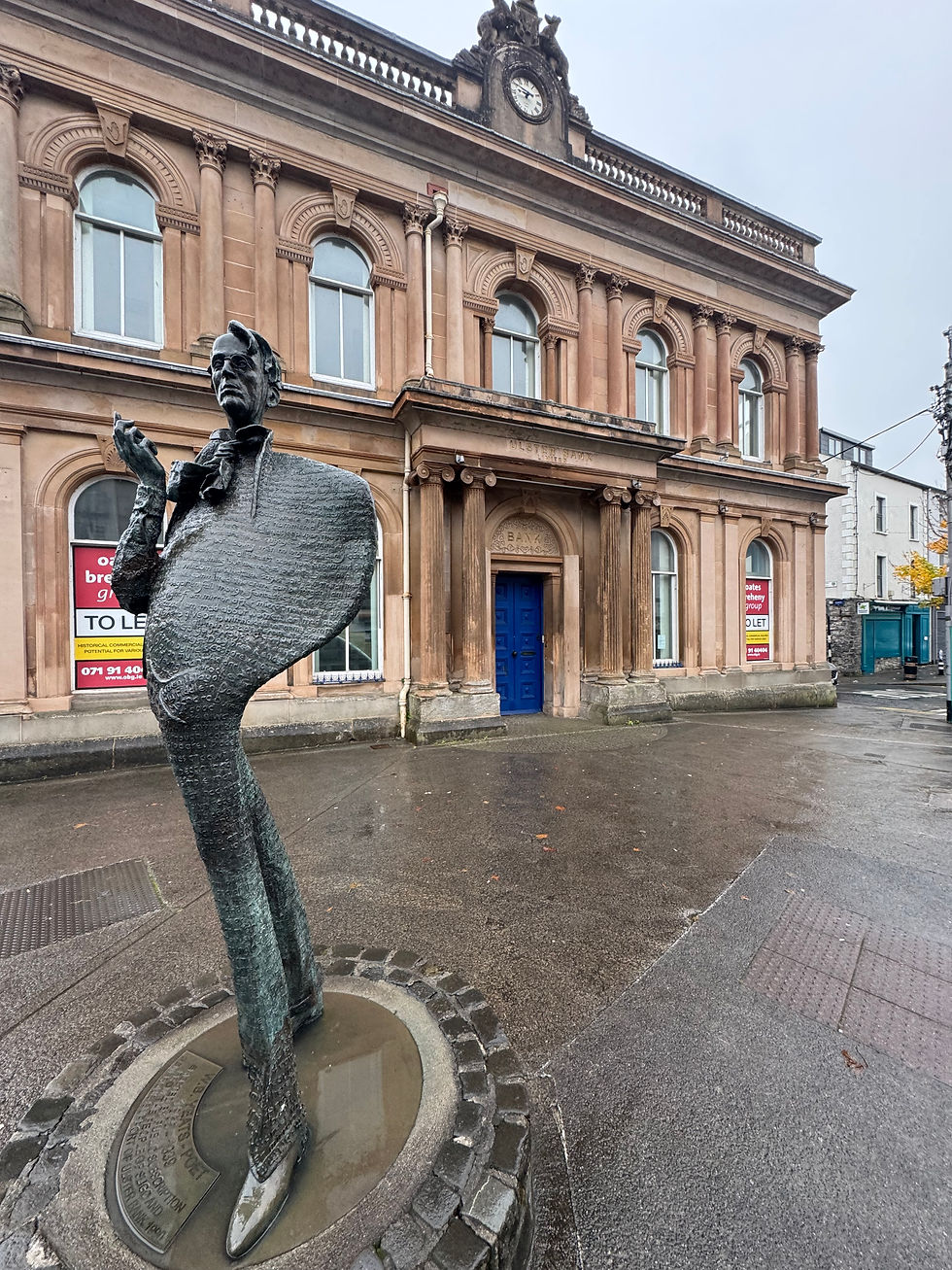
I’ve been thinking about Yeats a lot recently, and being in Sligo, those thoughts were amplified. I crossed the river to examine the statue of the great poet more closely. Every piece of clothing on this bronze cast statue is cut in relief with words from a hundred Yeats poems.
I was searching for a line from The Second Coming, and found instead, the crucial words from Easter, 1916 on the flap of Yeat’s bronze jacket - “a terrible beauty is born.”

Yeat's warning that the pursuit of an ideal - freedom, justice, liberation - is often ground out between the bloody millstones of war and chaos.
The Second Coming, as it turns out, is not represented in the folds of Yeat’s bronze clothing.
I know I’m not alone in repeatedly parsing lines from The Second Coming since the current US president came to power, again.
Each line is an augury. Each imperfectly-rhymed couplet an omen. The two stanzas, distilled to an essence more rare than the strongest Irish whiskey, are prophecies predicting our fate today, though they were written a hundred twenty five years ago.

In my country's daily reality the poorest among us face hunger, and our sickest court disaster, while our feckless leader coddles billionaires and celebrates excess while promising to mint coins bearing his own likeness. Is it any surprise that this holiday season we can confidently quote Yeats - “And what rough beast, it’s hour come at last/Slouches towards Bethlehem to be born.”
Our Canadian high priestess and poetess, Joni Mitchell, too found power in Yeats poem and created a song which carries the same poetic heft to an audience who may have never considered Yeats.
Her Slouching Towards Bethlehem remains mostly faithful to Yeat's words, while taking license for the rhythm and repetition a song demands.
Years ago, when I was still doing three hours of music on the radio each week, I compiled a long list of non-traditional holiday music, and Yeat's poem, embedded in Joni's song, earned a prominent spot, though it's not been as widely adapted for the season as her song River.
Still in this season of political darkness, her song, and Yeats poem serve as a reminder and a warning. The monster among us, is always one of us.
A shape with lion body and the head of a man,
A gaze blank and pitiless as the sun,
Is moving its slow thighs, while all about it
Reel shadows of the indignant desert birds
Sound familiar? It should.
That rough beast slouching towards Bethlehem has found a legion of followers and a phalanx of supplicants. And, as Yeats said, the darkness drops again.


Comments